Boatbuilding Joints
Strong, stable woodworking joints are required whatever type of Wooden Boat building you embark on.
Here are some of the joints most commonly used in boat building from traditional to stitch and glue.
Most of the bonding methods used in boat construction have evolved over many years.
However, modern adhesives have made gluing timber much simpler and stronger.
This has revolutionised home boat construction, bringing it within the scope of the average handyman.
The development of epoxy resins has led to new and greatly simplified construction methods.
Butt Blocks
A Butt joint supported by a butt block is the simplest method of joining planks.
On traditional carvel construction these are mechanical bonds rather than glued.
These are normally used to create long planks from shorter lengths of stock.
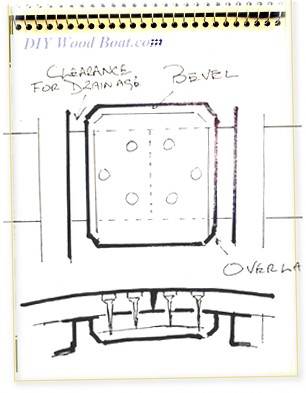
To be effective, the butt blocks should overlap the planks above and below by between ¼ to ½ of an inch, 6 to 12mm.
The blocks normally are of the same timber as the planking. However, it is not unusual to use a stronger wood and /or thicker stock.
It is quite acceptable to use wood screws to fasten a hardwood block.
With softwood it is best to use through-bolts.
A gap of at least ¼ of an inch, 6mm should be allowed between the block and adjacent frames to allow for drainage.
It is equally important to bevel the top edge of the block to stop moisture being channeled towards the back of the block.
The back of the block should be shaped to fit the compound cure of the planking.
It is best practice to have the grain of the block running in the same direction as the grain of the plank.
Prime the butt and underlying plank before fitting with a bedding compound.
Caulk the exterior of the butt.
affiliate linksScarf Joints.
 Scarf Joints
This is the method to use when gluing timber to make longer lengths.
It is also an economical method which, can be used to make shaped pieces from available stock.
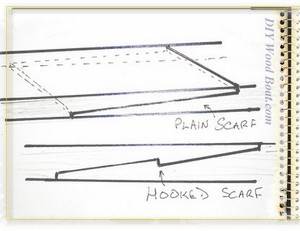
The point of the long scarf (or scarph) is to increase the strength of the joint by increasing the glued surface.
The length of the scarf should be in the ratio of at least 8:1 in relation to the thickness of the plank.The preferred ratio is 12:1 however that will depend on the application.
The faces of the scarf will need to be close fitting to facilitate gluing.There are simple jigs which can be made to ensure close mating.
The simplest scarf is feather ended however the ends are prone to damage.To overcome this it is normal to nib at least one end.
Stitch and Glue
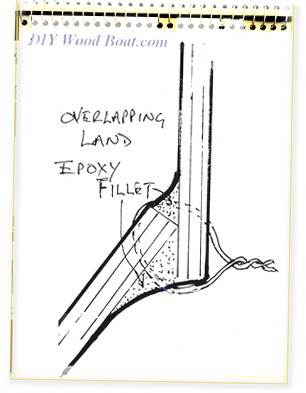
Stitch and Glue Joints make use of thickened Epoxy Resin to create fillets.
These make boat building simple without having to become a highly skilled woodworker.
The sections are initially held together with the wire ‘stitches’.
Fillets should be roughly 1.5 times the thickness of the plank.
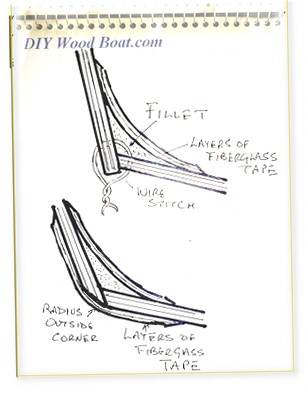
Once the fillets have cued
epoxy saturated tape is laid
over them with a good overlap.
To remove the wire heat it until the epoxy surrounding it softens. It can then be pulled out quite easily.
With the wire removed radius the outside corner.
Finish with epoxy saturated glass cloth.
affiliate linksNib scarf.
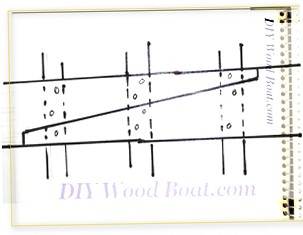
This is an alternative to using butt blocks where it is difficult to fit a block behind the planks.
The scarf is spread over several frames to give it sufficient strength.
This is a mechanical joint, which should be caulked.
NATIVE ASYNC


Recent Articles


-
Wooden Boat Events 2024
Apr 14, 24 05:15 AM
Wooden Boat Events 2024 calendar, traditional and classic boat festivals and regattas from around the world
You might like these
Plywood and Veneer Guide for Marine use.
A guide to plywood for boat building and why you should use the best marine grade you can afford.
DIY Woodboat Building Questions
Woodboat building questions a Forum for wooden boat building, plans, lumber, caulking compounds and other boat building problems.
Boat Books for Wooden Boat Builders
Boat Books a series of boat books based on some of the 1960's, classic, Free Boat Plans that were published in magazines such as "Popular Mechanics", "Popular Science" and the "Boat Builder Handbook".
Build a Boat, tips for the DIY Wooden Boat Builder.
How to Build a Boat, Wooden Boat Building methods for the DIY, backyard, self-builders explained, carvel, lapstrake and plywood
Clench Nails, Fastening for Small Wooden Boats.
How to use Clench Nails, these provide a fast reliable method for fastening small wooden boats.
Wood Screws for Boat Building and Repair.
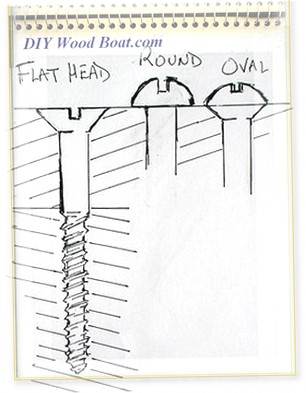
Wood Screws are the most widely used and versatile fasteners used on wooden boats. Which type to use and how to use them

Recent Articles
-
Wooden Boat Events 2024
Apr 14, 24 05:15 AM
Wooden Boat Events 2024 calendar, traditional and classic boat festivals and regattas from around the world -
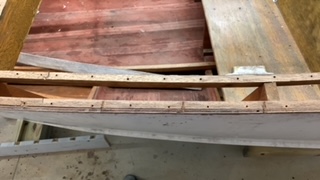
14’ 1956 Chris Craft, side rail how should it be attached?
Apr 12, 24 03:38 AM
 Removing the old side rail most of the screws went between the top deck/skin 1/4” plywood and the side of the hull. See photo, is this correct? I would
 -
How to laminate plywood on the hull
Apr 10, 24 03:46 AM
I'm working on replacing the bottom of 18' 1969 runabout that has a deep-V plywood hull. It had a 1/2 mahogany plywood bottom that they somehow got to
You might like these
Boatbuilding Tools for the Wooden Boat Builder.
The Boatbuilding Tools needed for building renovating or repairing wooden boats and how to sharpen and care for them.
Wire Twister Tool
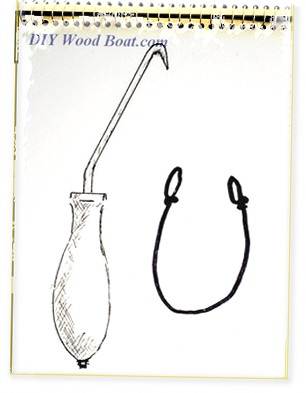
Tightening the stitches on a stitch and glue construction will be easier with a Wire Twister Tool, a cheap and simple gadget
Using a Hand Saw
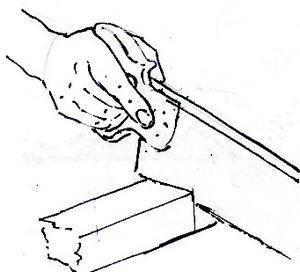
Using a hand saw, how to cut straight and square by hand with a wood saw.
Tool Care
Tool care, how to keep your boat tools rust free, shiny and sharp, especially those you keep onboard.
Sharpening and Honing
A guide to Sharpening and Honing woodworking tools, sharpening stones and strops for a keen edge.
Screwdrivers for DIY.
A bit about Screwdrivers and their use on wooden boat building projects.


This work is licensed under a Creative Commons Attribution-ShareAlike 2.0 UK: England & Wales License.
I am perfectly aware that the majority of Wooden Boat aficionados are sensible folk.
However, I need to point out that I am an amateur wooden boat enthusiast simply writing in order to try to help other amateur wooden boat enthusiasts.
And while I take every care to ensure that the information in DIY Wood Boat.com is correct, anyone acting on the information on this website does so at their own risk.