- Home
- Boat Building
- Restoration
- Supplies
Wooden Boat Supplies and Chandlery.
When sourcing Wood Boat supplies for your boat building and restoration projects your local marine chandlery is unlikely to have what you need in stock.
Their customer base will be predominantly plastic boat owners.
The best products to use will be entitled 'marine' but unfortunately that often means expensive.
The 'latest', 'hi tec' boat supplies products often come with high advertising mark-up.
Traditional boat building products which have been successfully used for generations are usually the cheapest option.
Fortunately we now have the internet where you can find boat supplies.
Timber
Before deciding on the timber you intend to use it is worth checking what supplies are available in you area.
Any lumber of sufficient widths, lengths and quality that you can not find locally will incur the extra expense of ordering, delivery and transport.
For most boat building you will want good quality seasoned and sustainable timber.
It will need to be free of heartwood and sapwood and as clear of knots as possible.
Air dried wood is rare these days but kiln dried is just as good. In some ways kiln dried, because the drying process is controlled can be better.
However it is a good idea to allow kiln dried wood to acclimatize before use.
Stack it and allow it to stand as it can be rather dry initially.
Most timber yards quote their prices for cut timber.
Unless you are very lucky, few yards will allow you to pick and choose the pieces you want but it is still worth knowing a little about the properties of timber .
Machining will be an extra, so decide if this is necessary for you.
And remember that machining will reduce the finished size.
The reduction will be somewhere in the region of 6mm depending on the type of machining and the skill of the machine operator.
Strip planking timber because it is machined is probably best ordered from a specialist boat supplies vendor.
Your local yard will charge you extra for having to specially set up the machining.
Plywood
'Green' Labeling. For most wooden boat building applications Marine Plywood is the only option.
However there are varying grades within the term 'marine plywood'.
And naturally enough they vary in price. It is possible to use cheaper grades of plywood in marine construction as long as it is completely sealed with epoxy resin.
However epoxies aren't cheap, the extra you spend on epoxy might negate any savings you make on wood. And remember that old saying about the ship being lost for the sake of a nail.
Think about finish as well. It's difficult to get a smooth non grainy finish of softwood ply.
Plywood , used properly is a wonderful material for the boat builder.
However, despite the veneers that are available, I personally, prefer to paint any exposed ply.
Varnished or oiled plywood never quite has the same beauty of solid wood.
Glue
There is a bewildering array of glues
on the boat supplies market today.
When choosing a glue you need to decide;
- Where it is going to be used.
- What degree of exposure will it receive?
- Will it be easy to repair?
- What are the health risks?
Epoxy systems
are superb glues, however, they are not always the most appropriate glue to use in a marine situation and there is an increasing unease about the health and environmental risks involved ( see below ). .
On traditionally built boats, epoxies' high strength can be a disadvantage.
Traditional building methods allow for, and sometimes rely on, movement of the wood.
Carvel planking for instance will need to swell (take up) to create a watertight hull.
My own preference for below the waterline is the resorcinol type ,
two part glue.
However it does leave a dark gluing line.
So, for above the waterline I have found a good quality water resistant Polyurethane glue an excellent choice.
Fastening Supplies
The corrosion of metal fastenings is complex. It can vary depending on the type of wood it is in contact with and the amount it is exposed to water.
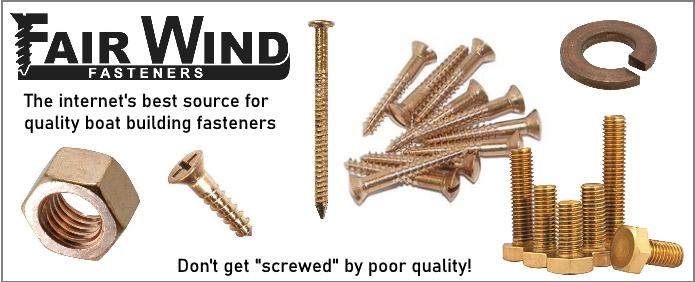
Of the available fastenings silicon bronze is the most suitable to use below the waterline.
Stainless steel is stronger harder and a little cheaper than silicon bronze.
However, the usual 304 type of stainless is not suitable for underwater fittings except perhaps for small boats which do not spend much time in the water.
Hot dipped galvanized fastenings are fine for large boats.
But, they will bleed and corrode, besides they are not easily obtained these days in supplies of good quality.
Care must be taken not to damage the galvanizing for the surface.
Brass screws will not last long if used below the waterline.
Monel is probably the best material for fastenings in a marine environment but it is expensive and supplies are difficult to obtain.
Copper is the material of choice for rivets roves and clench (clout) nails.
Silicon bronze gripfast nails are the best choice for other nailing applications.
Epoxy Systems
Warning
Epoxy Resins contain Bisphenol A.
Before using traditional petrolium based epoxies you should consider the flood of new scientific evidence on adverse effects of BPA.
With the increasing popularity of DIY boat building techniques such as 'stitch and glue' and 'strip planking' supplies of several epoxy systems are now available to the amateur builder.
Before embarking on a large project it is worth making sure that you are not allergic to epoxies.
And read and take notice of the safety precautions on the packet.
Resins come in differing viscosities, depending on whether you are using them for a thin, even coat of epoxy over wood or for a thicker application.
However, there are many types of filler available for thickening and for making fillets and general filling.
Most folk just mix in some sawdust.
Many come with differing hardeners for fast, medium or slow curing.
The rate of cure can be altered by adjusting the amount of hardener.
'Blush' a thin waxy layer that develops on the surface of the epoxy as it cures will need to be washed off and sanded before re-coating.
Acetone can be used as a good degreaser and cleaner but it is very volatile, flammable, and not always easily obtained.
Vinegar is a safer option especially for cleaning epoxy resin from human skin.
Some systems can be bought as a starter pack containing all those essential extras such as mixing sticks.
Glass matting, tape and fabric is available in varying sizes and types of differing applications.
You will also need rollers, brushes, gloves, copper wire, pots for mixing, mixing sticks and applicators.
Finishing
Which Paint to use and how to get a good finish.
A good paint job will transform the appearance of even the tattiest of old boats.
'Marine' paints and varnishes contain additives which increase their durability within the marine environment.
It is possible to use good quality exterior house paints.
However, these will, depending on how much time the boat spends in the water, need to be repainted more often.
The secret of a good finish be it varnish or paint is in the preparation.
I'm a great believer in using good old cheap creosote to treat bare timber.
This, when it has dried, can then be painted with oil based paint.
Bare wood should be primed and then several coats of a good quality marine undercoat applied, sanding between coats.
How much you are willing to spend on the quality of the top coat will depend on how often you are prepared to repaint.
Bottom paint or anti foul paint is applied to keep algae and barnacles from growing on the boat hull.
This is only necessary for boats which spend much of their time in the water.
Most supplies of anti-foul paints available today are designed to be environmentally friendly.
Sealants
There are numerous sealants and caulking compounds available in the boat supplies market.
However, there are different types for different purposes.
Most of the common Silicone sealants will not cure under paint or water and they are not intended or suitable for use below the waterline.
However, they are perfect for sealing around edges such as port lights, deck hardware and other topside applications.
If you are planning to use traditional putty for caulking, you will also need those unusual substances such as red led powder and caulking cotton.
Oakum is hemp soaked in tar oil for larger seams normally for work boats.
As an alternative there are several patented Seam Compounds which have been tried and tested.
These will remains durable and flexible, after immersion to absorb expansion and contraction of planks.
They must be applied over properly primed surfaces.
The mating surfaces between bolted wood joints must be bedded, preferably with a compound which allows for easy removal and is flexible.
Safety

"There is but a plank between a sailor
and eternity."
(Thomas Gibbons)
While I must admit to being cavalier about work safety it is in your own interests to invest in appropriate protective clothing.
Safety gear for boat building is easily obtained from any hardware store.
Safety on the water and especially at sea is something I am keen on.
Having put a lot of time and effort into building that boat of yours, the last thing you need is an accident when it is launched.
Safety is about more than boat supplies such as life jackets and the like which, can be bought in any chandlery.
It is also about knowing what you are doing on the water.
NATIVE ASYNC


Recent Articles


-
Wooden Boat Events 2024
Apr 14, 24 05:15 AM
Wooden Boat Events 2024 calendar, traditional and classic boat festivals and regattas from around the world
You might like these
Free Motorboat Plans
Free Motorboat Plans for the backyard home builder, build your own speed boat, cabin cruiser, runabout or utility boat using these simple plywood designs.
Wooden Boat Kits.
Wooden boat building is easy and inexpensive with wooden boat kits. From row boats and kayaks to sailing cruisers, boat to be proud of
DIY Woodboat Questions
Woodboat questions and answers forum for all Wooden Boat owners, advice and opinions on all aspects of wooden boat building, restoration and maintenance.

Recent Articles
-
Wooden Boat Events 2024
Apr 14, 24 05:15 AM
Wooden Boat Events 2024 calendar, traditional and classic boat festivals and regattas from around the world -
14’ 1956 Chris Craft, side rail how should it be attached?
Apr 12, 24 03:38 AM
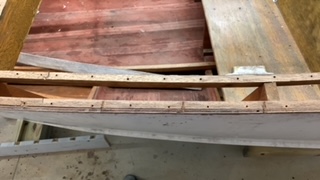
 Removing the old side rail most of the screws went between the top deck/skin 1/4” plywood and the side of the hull. See photo, is this correct? I would
 -
How to laminate plywood on the hull
Apr 10, 24 03:46 AM
I'm working on replacing the bottom of 18' 1969 runabout that has a deep-V plywood hull. It had a 1/2 mahogany plywood bottom that they somehow got to
Free Motorboat Plans
Free Motorboat Plans for the backyard home builder, build your own speed boat, cabin cruiser, runabout or utility boat using these simple plywood designs.
Wooden Boat Kits.
Wooden boat building is easy and inexpensive with wooden boat kits. From row boats and kayaks to sailing cruisers, boat to be proud of
DIY Woodboat Questions
Woodboat questions and answers forum for all Wooden Boat owners, advice and opinions on all aspects of wooden boat building, restoration and maintenance.


This work is licensed under a Creative Commons Attribution-ShareAlike 2.0 UK: England & Wales License.
I am perfectly aware that the majority of Wooden Boat aficionados are sensible folk.
However, I need to point out that I am an amateur wooden boat enthusiast simply writing in order to try to help other amateur wooden boat enthusiasts.
And while I take every care to ensure that the information in DIY Wood Boat.com is correct, anyone acting on the information on this website does so at their own risk.