- Home
- Ropes and Rigs
- Knots
- Rope Types
- Splicing
- Whipping
- Blocks and Tackle
- Handy Billy
- Balanced Lugsail
The Balanced Lugsail
The
balanced lugsail is one of the cheapest and easiest rigs
to set up on a small boat.
They can even outperform the modern bermudan sail in certain conditions and points of sail.
It is the most popular form of lug sail for small boats as it is powerful, docile and easy to handle.

Lug versus Bermudan
In
terms of overall efficiency, a well set up bermudan sail will
out perform a well set up and properly trimmed lug sail.
However, it is rare indeed to find an average small boat cruiser who
does set, trim and sail his bermudan sail efficiently.
For the average non
racing sailor any differences in sailing efficiency
will be barely noticed.
What will be noticeable is the reduced cost of the rig, the ease of
setting it up and the ease of actually using it.
One of the problems with the balanced lug, is having the sail distorted
when it is pressed against the mast on one tack, something that the
dipping lug overcomes.
However the ease of tacking far outweighs any slight loss of
efficiency, a loss that the average cruiser will barely notice, to tack
a balanced lug merely push the tiller over.
The other argument the bermudan aficionados trot out, is its ability to
sail closer to the wind but so often these same folk will be the first
to get tired of the effort of tacking up a narrow channel and switch on
the engine.
Once the sheets are eased however the balanced lugsail really begins to
prove its worth, down wind they can outperform the bermudan unless it
goes to all the bother of hoisting and controlling a spinnaker.
What the bermudans don't mention is that the wind close to the
surface
is slower and less powerful than the wind at the top of the mast.
Yet that triangular sail is at its smallest at the top, whereas more
traditional, less hi tec rigs such as the balanced lug have
plenty
of sail area up there where the wind is at it's most free.
But I guess that if you have just spent a fortune on a bermudan rig and
all its
attendant necessary bits you need to find a way of justifying the
expense.
Small Boat Rigs

On "Mignonne" I
have elected to use the fully battened Chinese
version
of the balanced lug.
For a dinghy or any smaller boat, a simple' western' balanced lug is
probably the
better option because of its simplicity.
The junk rig may give more control over the sail shape and more bits of
string to play with but those extra bits of string do need the extra
space on deck and in the cockpit to keep them tidy.
Apart from the ease and cheapness of these rigs there are other
advantages.
Because of the balanced lugsail shape, a given sail area requires a
much
shorter mast then for a similar bermudan sail area.
And that sorter mast means;
- less windage when the sail is dropped,
- it is much easier to stow, especially when trailering,
- and a much easier climb to fix mast top fitting on a permanently stepped mast.
The Basic Balanced Lugsail
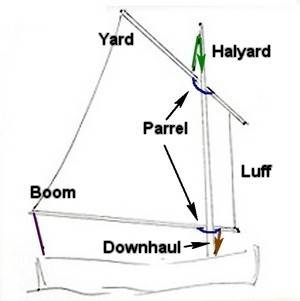 The Basic Ballanced Lug Sail
We
tend to describe the balanced lugsail as being 'square' however,
strictly speaking most are quadrilaterals, as the opposing edges are
rarely parallel.
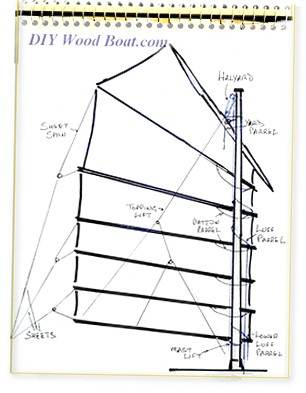
The basic characteristic of all lug sails is that the sail is hung from
a yard in such a way that the majority of the sail hangs behind the
mast while the leading edge extends forward in front of the mast.
The yard is raised and lowered by means of the halyard and is loosely
held to the mast by a short length of line known as a 'parrel'.
It is normal to find a Lug sail hung from the port side of the mast,
this
seems to be from convention rather than from any practical reason.
With the balanced lugsail the lower edge of the sail is
attached to a boom, which also continues forward of the mast to hold
the luff of the sail.
The boom usually has a parrel holding it to the mast, a controlling
sheet at the clew end and most importantly it will have a downhaul at
the forward end.
The downhaul is used to control the luff tension.
While a balanced lugsail mast is usually short and stiff, the yard and
boom
should have some flexibility, which is another good reason for using
wooden spars.
A certain amount of flex in the boom and yard will allow the sail to
develop some curvature.
The amount of hardware/fittings required for a balanced lug will depend
on the size of the sail.
- Basically you need a block or sheave at the mast head to take the halyard and somewhere to tie off the halyard.
- Tackle and rope clutch to control the downhaul.
- And somewhere to tie off the sheet.
Clearly the larger, heaver and more powerful the sail the greater will
be the need for extra purchase, especially on the halyard.
However, as the forces involved and need to constantly adjust are minimal there is really no need to spend a fortune on hi tec, fancy, 'friction free' blocks.
The only concession to hi tec might be the use of low stretch rope for the halyard.
It is possible to set up a jiffy reefing system that could be operated
from the cockpit or even roller reefing around the boom.
But to my mind this will only detract from the beautiful simplicity of
the
rig.
And with every added complication comes the risk stuff going wrong,
line
tangles extra friction, etc.
What could be simpler and less prone to snarl ups that a set of reefing
tapes sewn on and ready to tie.
One slight complication that might be worth while considering is a
combined topping lift / lazy jack to make dropping the sail that bit
tidier.
The balanced lugsail is
one of
the best traditional rigs, especially for
small boats.
It is a rig that is
capable of very good performance, however this
depends on getting the shape and set up right for your particular boat.
The position of the mast
and how the spars and control lines are
attached will also affect how she performs.
NATIVE ASYNC
Previous posts
See What Others Have Posted
Abie Porpoise
I love this site!
Thank you for your hard work. Great resource!
I think I would like a balanced lug on this J. Atkins dory that I intend to build. …
Need Help Planning a Lugsail to replace a Bermudan
Hi, I am considering building an 18 foot stitch-n-glue weekend cruiser sailboat whose designs include a bermudan sail and mast, etc.
However, I would …


Recent Articles


-
Wooden Boat Events 2024
Apr 14, 24 05:15 AM
Wooden Boat Events 2024 calendar, traditional and classic boat festivals and regattas from around the world
You might like these
The Dipping Lug Sail
The dipping lug sail, is perhaps the most efficient and cheapest, type of sailing rig especially for small sailboats however it isn't as handy as the standing lugger or the balanced lugsail.
UV Strip for Furling Sails
UV Strip, notes on repairing, fitting and replacing a sacrificial UV protection strip on furling sails using acrylic or UV protected Dacron.
Sailing Rigs, a Guide to Sail Shapes.
The basic shape of the Sailing Rigs most commonly found on wooden sailing boats of every size.
Sail Cloth
About sail cloth and the different materials for DIY sail making and the average leisure sailor.
Sail Balance
Notes on Sail Balance, designing a sailing rig, how set the relationship between the center of effort and the center of lateral resistance.
Lug Rigs for large and small sailboats.
Sailors have been using Lug Rigs for centuries because of their unique sailing abilities.
Junk Rig the ideal cruising sail.
How to rig a western version of the Chinese Junk Rig the basic lines and controls.
Junk Rig, How I Made My Own.
Junk Rig Sails How I built and rigged Mignonne with a Juk Sail
Junk Rig Conversion
Structural considerations for a Junk rig conversion of a wooden boat from bermudan rig to junk sail, where and how to site the mast.
Chinese Junk, the perfect cruising rig.
Chinese junk sail, why I rigged Mignonne with a Jukn Sail




Recent Articles
-
Wooden Boat Events 2024
Apr 14, 24 05:15 AM
Wooden Boat Events 2024 calendar, traditional and classic boat festivals and regattas from around the world -
14’ 1956 Chris Craft, side rail how should it be attached?
Apr 12, 24 03:38 AM
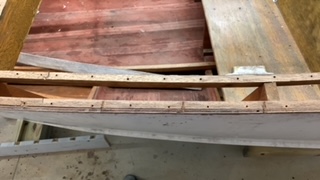
 Removing the old side rail most of the screws went between the top deck/skin 1/4” plywood and the side of the hull. See photo, is this correct? I would
 -
How to laminate plywood on the hull
Apr 10, 24 03:46 AM
I'm working on replacing the bottom of 18' 1969 runabout that has a deep-V plywood hull. It had a 1/2 mahogany plywood bottom that they somehow got to
You might like these
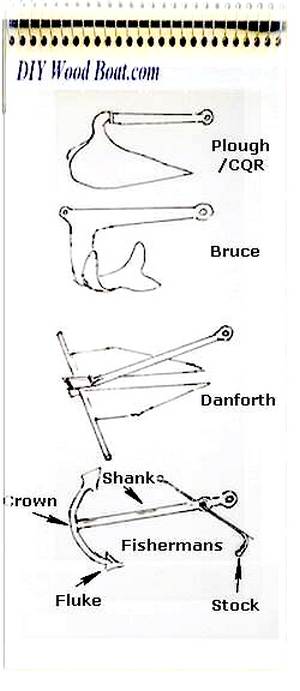
Anchor Types
Anchor types, how to choose the type, size and style of ground tackle, chain and rode to anchor your boat safely.
Cruising in Wooden Boats, the Eco Lifestyle
Freedom wooden boat Cruising, adventure, boat handling, navigation safety for wood boat builders.
Anchoring Techniques
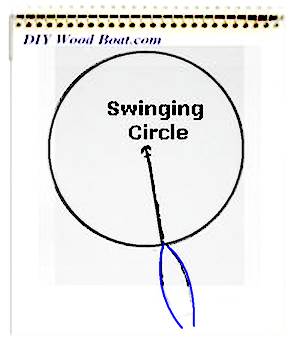
Anchoring techniques, best practices to ensure the safety of you and your boat, and how to retrieve a snagged hook.
DIY Boat Yards
DIY boat yards, do you know of or are looking for facilities and hard standing where wooden boats are welcome and where owners can do their own thing free from bureaucratic harassment.
Passage Planning for Small Boat Cruising
Passage Planning, a concise and easily understood cruise plan, for any of voyage from a dinghy trip around the bay to, cruising boat navigating an ocean.






This work is licensed under a Creative Commons Attribution-ShareAlike 2.0 UK: England & Wales License.
I am perfectly aware that the majority of Wooden Boat aficionados are sensible folk.
However, I need to point out that I am an amateur wooden boat enthusiast simply writing in order to try to help other amateur wooden boat enthusiasts.
And while I take every care to ensure that the information in DIY Wood Boat.com is correct, anyone acting on the information on this website does so at their own risk.