- Home
- Cabin Cruisers
- Ergonomics
- Bulkhead
- Cabin Trunk
- Dorade
- Panels
- Ventilation
- Boat Bunks
Boat Bunks Design and Building
All boat bunks need, primarily, to be comfortable.
However, on every small boat space is a premium.
So, like everything else on a small boat the bunks should be able to perform more than one function
The most common arrangement is the settee berth, which is used for seating during the day but converts into a bunk for sleeping.
Settee Berth.
Boat builders are an inventive lot and over the centuries they have come up with innumerable ingenious sleeping arrangements.
This is especially true of wooden boat owners.
Much depends on the space available after all the other essentials, such as galleys, chart tables etc have been catered for.
The settee or transom berth is the most common arrangement.
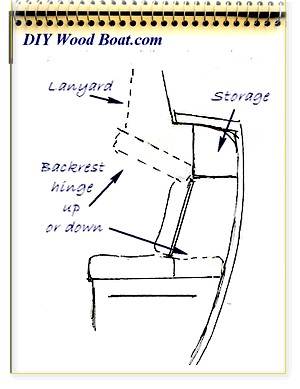
Unfortunately what is comfortable for sitting is too narrow for the average person to sleep on, (see the page on ergonomics .)
So, some method of extending boat bunks for night time use is needed.
The hinged backrest is an excellent idea where the space behind can be used, during the day to store the bedding.
The backrest needs to be at and angle of about 10 degrees from the vertical to be comfortable during the day, yet be out of the way for comfort during the night.
Various other methods have been used such as using in-fills to increase their width between settees.
The fold away saloon table top can double up as part of the infill.
On one of my previous boats had settees on either side of the saloon, the infill was made up of 12inch / 305mm boards, these were easy to store and I often used just one as a 'coffee table'.
Another method is to have an extension which slides out from underneath.
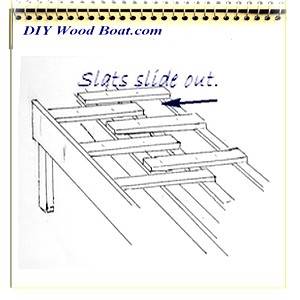
However, if you use the 'padded' backrest as an infill there is no need to find storage space for the extra 'mattress'.
All that space under the settees makes for ideal storage space.
This space can be accessed fro the front.
However, as this will be quite a deep space, access will be easier from the top.
And the openings can be made quite large, accessed from under the padding / mattress.
However covers for the openings must be constructed securely so they do not give way under a large bottom or bouncing child (unless you deliberately want to get rid of them).
And take care when using knotty Wood as framing timber.
Pilot Berth.
The Pilot berth or sea berth is usually a fixed affair which is only found on biggish boats.
Quite often they end up being used as storage areas for bags and the like rather than boat bunks for sleeping on.
Quarter berth.
The 'Quarter berth' is an excellent use of that 'tunnel' under the cockpit seats or aft side deck.
Although some find them too claustrophobic for comfort, they can be snug, safe bunks for use at sea.
The major down side of the quarter berth is often the lack of ventilation.
The bottom end of that dark tunnel can become damp and smelly.
A vent of some sort at the bottom end will help keep it smelling sweet however, this will need to be one which can be closed easily in foul weather, such as a mushroom vent.
Pipe Cot.
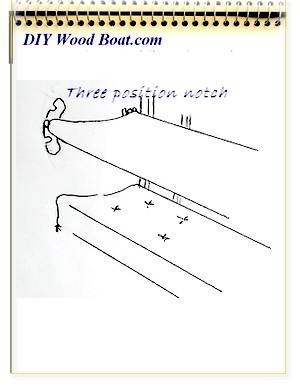
The basic pipe cot is regarded as a space saving utilitarian arrangements only fit for occasional use.
However, they can be very comfortable boat bunks, especially when underway.
And with a bit of imagination they can be designed to be converted into comfortable seating areas for daytime use.
The usual arrangement is rather like a stretcher with a canvas base either sleeved or laced on to supporting poles.
The 'temporary' arrangement I erected on Mignonne is still in use.
Originally it was set up while I was rebuilding Mignonne so I could sleep on board.
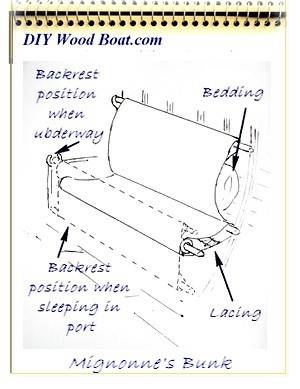
But I was then still at the stage where I was not ready to build something permanent.
Neither did I want to spend money or time on upholstery which would most likely soon become grubby.
It also needed to be convenient and easy to stow and erect and have somewhere to hide my bedding.
Nor I did not want to spend too much time building it.
However it turned out to be so comfortable and convenient that the original contraption is still there.
affiliate linksLee-cloths and Safety Boards for Boat Bunks.
The off watch crew trying to sleep on board, at night, at sea need something to prevent them from rolling off their boat bunks as the boat heels.
Falling asleep on the leeward, downhill side is fine but if the helmsman changes tack you could be thrown across the cabin, not the nicest way to be woken up.
The lee-cloth is probably the best solution to keep you in your bunk.
A good, stout, canvas cloth, well secured is much more comfortable than a board and easier to stow during the day.
And the lee-cloth will do away with the need for any hard, wooden lip at the edge of the seating which will uncomfortably dig into the back of the sitter's knee.
affiliate linksVentilation.
As a wooden boat owner you will not have the same degree of condensation and mildew as those poor relations, the plastic boat owners.
However, damp and mildew are an ever present danger in any boat.
It is common practice to build boat bunks from plywood over a wooden frame work.
While this is an excellent construction method the ply on the top of the bunk / settee needs to be pierced with ventilation holes to allow the upholstery to breathe.
I've already mentioned the need for ventilation at the bottom end of quarter berths, fore peak berths can also suffer from poor air circulation.
Mildew can be eradicated by a good spaying with vinegar however that is no substitute for good ventilation.
The more air flowing through the boat at all times, whether through mushroom vents dorades or other means the better not just for your boat bunks but the boat as a whole.
NATIVE ASYNC


Recent Articles


-
Wooden Boat Events 2024
Apr 14, 24 05:15 AM
Wooden Boat Events 2024 calendar, traditional and classic boat festivals and regattas from around the world
You might like these
Plywood and Veneer Guide for Marine use.
A guide to plywood for boat building and why you should use the best marine grade you can afford.
DIY Woodboat Building Questions
Woodboat building questions a Forum for wooden boat building, plans, lumber, caulking compounds and other boat building problems.
Boat Books for Wooden Boat Builders
Boat Books a series of boat books based on some of the 1960's, classic, Free Boat Plans that were published in magazines such as "Popular Mechanics", "Popular Science" and the "Boat Builder Handbook".
Build a Boat, tips for the DIY Wooden Boat Builder.
How to Build a Boat, Wooden Boat Building methods for the DIY, backyard, self-builders explained, carvel, lapstrake and plywood
Clench Nails, Fastening for Small Wooden Boats.
How to use Clench Nails, these provide a fast reliable method for fastening small wooden boats.
Wood Screws for Boat Building and Repair.
Wood Screws are the most widely used and versatile fasteners used on wooden boats. Which type to use and how to use them
Timber, Lumber for Boat Building.
A brief description of the most common Timber used for building Wooden Boats how to choose wood for your project boat
Timber Properties
A brief guide to timber properties and wood, characteristics such as strength, stiffness and elasticity for choosing lumber for wooden boat building and restoration.
Rivets and Copper Rove Wood Boat Fastenings.
How to use Copper Rivets and Roves construction guide to fasteners on your wooden boat.
Ring Nails for Marine Fastening.
Ring Nails sometimes call Gripfast or ring shank, silicon bronze boat nails are renowned for their holding power. but how to get them out?




Recent Articles
-
Wooden Boat Events 2024
Apr 14, 24 05:15 AM
Wooden Boat Events 2024 calendar, traditional and classic boat festivals and regattas from around the world -
14’ 1956 Chris Craft, side rail how should it be attached?
Apr 12, 24 03:38 AM
 Removing the old side rail most of the screws went between the top deck/skin 1/4” plywood and the side of the hull. See photo, is this correct? I would
 -
How to laminate plywood on the hull
Apr 10, 24 03:46 AM
I'm working on replacing the bottom of 18' 1969 runabout that has a deep-V plywood hull. It had a 1/2 mahogany plywood bottom that they somehow got to
You might like these
Free Motorboat Plans
Free Motorboat Plans for the backyard home builder, build your own speed boat, cabin cruiser, runabout or utility boat using these simple plywood designs.
Wooden Boat Kits.
Wooden boat building is easy and inexpensive with wooden boat kits. From row boats and kayaks to sailing cruisers, boat to be proud of
Supplies for Wooden Boat building and Maintenance
Supplies for Wooden Boat Building and restoration, how to choose the materials and marine chandlery for your project.
DIY Woodboat Questions
Woodboat questions and answers forum for all Wooden Boat owners, advice and opinions on all aspects of wooden boat building, restoration and maintenance.
Small Boats, Made of Wood
What Everybody ought to know about building Small Boats, guidance and tips for self-building or restoring.
Sailboat Plans
Free Sailboat Plans for the backyard home builder, build your own wooden sailboat using these simple plywood designs.
Rowing Boat Plans
Free Rowing Boat Plans for the backyard home builder, build your own rowing boat, dory, folding dinghy or pram using these simple plywood designs.


This work is licensed under a Creative Commons Attribution-ShareAlike 2.0 UK: England & Wales License.
I am perfectly aware that the majority of Wooden Boat aficionados are sensible folk.
However, I need to point out that I am an amateur wooden boat enthusiast simply writing in order to try to help other amateur wooden boat enthusiasts.
And while I take every care to ensure that the information in DIY Wood Boat.com is correct, anyone acting on the information on this website does so at their own risk.