- Home
- Your Boats
- Catamarans
Wooden Catamarans
The advantages Catamarans have for the home builder are that they can be cheap and relatively simple to build, depending on the design.
The hulls can be simple V shaped stitch and glue constructions connected by a timber bridge deck, as in the famous Wharram designs.
Catamaran Origins.
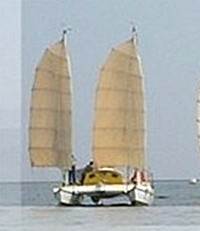
Multi hulled boats have been in use among fishing and seafaring communities since time immemorial.
The word, catamaran comes from the Tamil language of Southern India where they were used for fishing.
And of course twin hulled vessels have long been in use in Polynesia.
The Polynesians covered huge distances across the Pacific in their quest to settle some of the worlds most isolated islands.
Their vessels ranged from small outrigger Proas for fishing to enormous catamarans for voyaging.
Advantages.
Despite skepticism from mono-hull sailors, multi hulled vessels have become popular for every type of vessel from tiny beech cats, pontoon boats, cruising sail boats to high speed ferries.
For the home builder the greatest advantage is the ease of construction and the consequent cheapness.
At sea the advantages are numerous.
- Because the multi-hull only heals slightly and doesn’t rock so much, there is less risk of seasickness than on a mono-hull.
- The ease of motion also reduces the risk of injury and from falling overboard.
- A lack of heal also makes life on board more comfortable and less tiring.
- Those narrow hulls are more easily driven at speed.
- While this is clearly an advantage for those seeking thrills on small boats, it can also cut journey times for the cruiser, allowing more time to enjoy that anchorage.
- The multi hull's shallow draft means that they can sail and moor in shallow water, and because the twin hulls keep her level, drying out on a beach or drying anchorage is a breeze.
- The bridge decks of larger cruising designs can be very spacious, making them an ideal place for relaxing while moored up.
- It is quite common the have netting stretched between the bow hulls also offers a superb place to relax and watch the ocean slipping by underneath.
- And having the accommodation split between the hulls allows for greater privacy for the crew.
- Having two hulls also means that if there should be an unfortunate accident it is unlikely that both hulls will be holed.
Disadvantages.
In
the early days of western sailing multi-hull design, there was
considerable fear of capsize.
The worry was that where a displacement mono-hull would self right an overturned cat would not.
This lead to some being equipped with enormous flotation bubbles at the top of the masts.
Since then it has become established that unless the boat is very light and being sailed at extreme limits, a capsize extremely unlikely.
Having the accommodation of a cruising multi-hull divided between the hulls does limit the size of the cabins.
This could be a disadvantage for small boat cruising and for living aboard.
Many trimaran designs attempts to overcome this by having a larger central hull with smaller outriggers.
Despite this many larger catamarans with large bridge decks and wider hulls are becoming popular as cruising boats.
Previous posts
See What Others Have Posted
I want to put amas on my kayak for sailing.
I want to put amas on my kayak for sailing.
It is 13' fiberglass.
But I am thinking of making them of plywood sides with board top and maybe bottom, …


You might like these
Cold Water Boating
Safety precautions for cold water boating and winter sailing
How to Mooring Your Boat.
Avoid embarrassment when Mooring and Docking, learn how to get it right safely with the correct lines and at least appear competent.
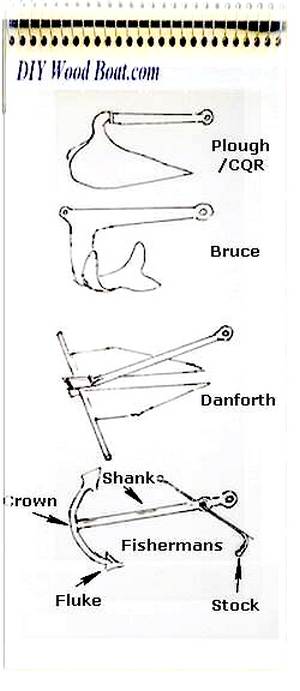
Anchor Types
Anchor types, how to choose the type, size and style of ground tackle, chain and rode to anchor your boat safely.
Recent Articles

-
Reader's Boat Photos
Aug 23, 25 09:08 AM
 Gallery of Readers uploaded Photos
 -
The Sliding Bevel
Jun 19, 25 02:52 AM
 By Robin Gates
The Sliding Bevel: A Boatbuilder’s Tool for Precision
For angles other than the perpendicular of the try-square and 45 degrees of a mitre-square, the essential measuring tool is a slidin…
-
Winter Bilge Issues
Jun 18, 25 07:34 AM
 By Adrian Morgan
Winter Bilge Issues: Can a Classic Boat Spend Too Long Ashore?
Beware the score of too long ashore, Adrian Morgan warns us…
Continue reading "Winter Bilge Issues"


This work is licensed under a Creative Commons Attribution-ShareAlike 2.0 UK: England & Wales License.
I am perfectly aware that the majority of Wooden Boat aficionados are sensible folk.
However, I need to point out that I am an amateur wooden boat enthusiast simply writing in order to try to help other amateur wooden boat enthusiasts.
And while I take every care to ensure that the information in DIY Wood Boat.com is correct, anyone acting on the information on this website does so at their own risk.