- Home
- Your Boats
- Letting Go
Letting Go a Mooring or Anchor from the Cockpit.
Here is a simple device for letting go a bow mooring or even an anchor from the cockpit.
It will allow a single hander to drop the mooring without having to leave the cockpit.
This is particularly useful when letting go of a mooring in a restricted space particularly if there are cross winds or currents.
There will be times when your boat needs to be in gear and making way the moment the mooring is let go.
Any boat needs to be traveling at a couple of knots through the water before the rudder has sufficient bite to control the vessel.
For the helmsman who has a competent crew on the bow and with clear communications this should be a simple maneuver.
However, for the single hander it is impossible to be in two places at the same time.
So, he needs some way to release the bow mooring while at the helm and in control of the engine or sheets, if he is sailing off the mooring.
Cat Hitch.
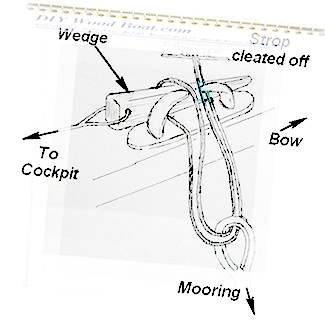
This is a simple variation on the method used by sailing ships to release the anchor from the cathead.
All it requires is to 'cat' the mooring then run a release line back to the cockpit.
The release mechanism is a simple hardwood wedge, a tapered piece of wood, with an attached line that will reach back to the cockpit.
This wedge is used to 'stop' a loop of rope which is holding the boat to the mooring.
Now there are many variations on this theme but this is how mine is arranged.
I have a strop of rope attached to the mooring line which I lay through a large, well secured fairlead then use the wedge to hold it in place.
The strop is long enough to allow me to secure it with the wedge before taking the weight off the mooring cleats.
Ready to let go forward.
Preparation is the key to successful boat maneuvering.
This is particularly true for the single hander.
So before leaving a mooring check the wind direction and tide flow and consider how this will affect your boat when you let go.
Start the engine, allow it to warm up, check the cooling water etc and check that the gears engage.
Clear away any unwanted lines check that there are none trailing in the water that could foul the prop.
Now, assuming that you have decided that the best direction to leave the mooring is into the wind, release and clear any stern moorings.
'Cat' the mooring strop then un-cleat the mooring lines.
As you let them go make them easy so that the strop takes the strain and check that it is secure.
Make sure all the mooring lines and pickup buoys are overboard and clear.
You can now return to the cockpit grab the helmet, engine in gear pull the release and off you go.
Letting go the Anchor
The same sort of arrangement could be used to 'cat' the anchor prior to deploying .
However, if you just cat the anchor by the crown the flukes will be left swinging and could damage the hull.
Unless the 'cathead' is well clear of the hull there are better methods for letting go of the anchor.
Books


You might like these
Cold Water Boating
Safety precautions for cold water boating and winter sailing
How to Mooring Your Boat.
Avoid embarrassment when Mooring and Docking, learn how to get it right safely with the correct lines and at least appear competent.
Anchor Types
Anchor types, how to choose the type, size and style of ground tackle, chain and rode to anchor your boat safely.
Recent Articles

-
Reader's Boat Photos
Aug 23, 25 09:08 AM
 Gallery of Readers uploaded Photos
 -
The Sliding Bevel
Jun 19, 25 02:52 AM
 By Robin Gates
The Sliding Bevel: A Boatbuilder’s Tool for Precision
For angles other than the perpendicular of the try-square and 45 degrees of a mitre-square, the essential measuring tool is a slidin…
-
Winter Bilge Issues
Jun 18, 25 07:34 AM
 By Adrian Morgan
Winter Bilge Issues: Can a Classic Boat Spend Too Long Ashore?
Beware the score of too long ashore, Adrian Morgan warns us…
Continue reading "Winter Bilge Issues"


This work is licensed under a Creative Commons Attribution-ShareAlike 2.0 UK: England & Wales License.
I am perfectly aware that the majority of Wooden Boat aficionados are sensible folk.
However, I need to point out that I am an amateur wooden boat enthusiast simply writing in order to try to help other amateur wooden boat enthusiasts.
And while I take every care to ensure that the information in DIY Wood Boat.com is correct, anyone acting on the information on this website does so at their own risk.