- Home
- Boat Building
- Restoration
- Electrics
- Battery Charging
- Battery Box
Making a Battery Box for a Wooden Boat.
A battery box or dedicated battery locker will make sure your batteries are well secured and safe.
Apart from safeguarding against the health dangers associated with
unsecured
batteries a well designed box will help to maintain those crucial
electrical
connections.
Even if you never suffer a knock-down, swamping or stranding, the constant movement of any boat will be detrimental to an unsecured battery.
And acid spills are
certainly not something you need
in a Wooden Boat.
I would recommend you use the 'gel'
type of
battery, especially in
a Wooden Boat..
They are the safest where there is a lot of movement, when things get
rough.
They produce less gas and they tend to hold their charge much longer
when not
in use, provided they are isolated.
However, they do have specific charging requirements..
Safety concerns.
- Faulty, or poorly installed electrical systems are danger to you your crew and the boat.
- Short circuits and overheating cables are a common cause of boat fires.
- Hydrogen is a highly flammable gas that is produced when charging your batteries, it is easily ignited by low energy sparks.
- Boat electrical systems must be designed, installed and maintained to minimise the risks of explosion or of fire.
- Your electrical systems must be capable of being safely and quickly disconnected from the power source in an emergency.
- Battery compartments which contain unsealed or open-vented batteries must be ventilated overboard to prevent a build-up of flammable hydrogen gas.
- The battery compartment needs to be sealed to prevent acid from a spill or cracked or damaged case escaping.
- Batteries should not be installed within 12inch/300mm of any petrol or LPG system components.
Battery Box Design.

The box is one of the few places where, even on a traditional wooden boat, that epoxy and glass fiber should be used.
The box can be made from plywood scraps.
All the interior joints should be sealed with epoxy resin with a filler, and the external corners fiber-glassed.
And the box should then be fiberglass lined.
There are some epoxy resins available which are supposedly acid resistant such as fluorocarbon resins.
However, normal epoxy fiberglass should be sufficient for all except the most extreme situations.
But do not use the cheaper polyester resins as the bonds will be weaker.
The batteries need to be held securely to prevent movement.
However there should be breathing space around the battery as well.
Two or three wooden slats fixed to the inside surfaces of the box will hold the battery secure yet clear of the box sides.
Strips of neoprene glued to the slats will help dampen any vibration or knocks.
While there is the need to hold the battery secure it shouldn't be so tight as to make removal difficult.
When designing a box for your battery and deciding where to position it, consider how easy it will be to remove and replace the battery.
Batteries are heavy and handling them in a confined space could lead to physical injury.
In some installations it may be necessary to lift those heavier batteries out sideways.
The box could be made with a removal side.
However I would recommend at the very least a having a lip at the bottom so that the is a sealed tray to collect any spilled acid.
The side panel will also need to have a gasket seal of some sort such as neoprene to contain any gasses produced while charging.
Venting.
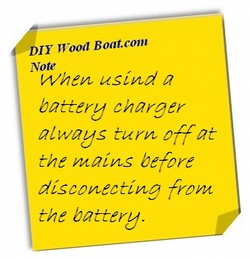
When charging batteries produce Hydrogen gas which could go bang.
The older the battery the more likely it is to produce more gas.
Hydrogen gas is extremely flammable the slightest spark will set off an explosion.
This is why battery boxes especially those in the accommodation areas should vent to the outside.
You will need to provide a vent from the highest point of the box to outside of the boat.
As hydrogen is lighter than air it will rise up until blocked.
A simple hole in the top of an exterior battery compartment will suffice.
However this gas must not be trapped in the boat.
So any interior battery boxes should have vents and venting pipes fitted to the very top of the battery box.
Battery Stowage.
One often over looked advantage of a well built 'water tight' battery box is that as well as keeping in any acid spills and gasses, it will also help keep water out.
Keeping all the electrics well above the bilges and the risk of water ingress is always a problem when fitting out a small boat.
The main difficulty is that heavy battery.
How to keep these heavy objects as low and central as possible, so as to keep the center of gravity low and central, yet keep them well out of the reach of any sloshing bilge water.
While most things on a small boat are a compromise a well sealed battery box could also help make the stowage problem less of a compromise.
NATIVE ASYNC


Recent Articles


-
Wooden Boat Events 2024
Apr 14, 24 05:15 AM
Wooden Boat Events 2024 calendar, traditional and classic boat festivals and regattas from around the world
You might like these
Anodes for the galvanic protection on Wooden Boats.
Sacrificial Anodes protect old and new wooden boat against electrolytic and stray current corrosion
Lightning Protection for Wooden Boats
Lightning Protection for Wooden Boats, what is the best system to reduce damage, injury and even death from strikes and electrical storms, conductors, bonding, faraday's cage
LED nav lights for small boats.
Led nav lights the most energy efficient navigation lights are now becoming more affordable for the small boater and well worth the cost of conversion for the savings on battery power.
Boat Navigation Lights, the Rules.
Do your Navigation Lights comply with the COLREGS? Enjoy safe night sailing and anchoring with the correct lights.
Boat Electrics, batteries and charging.
What Electrics a boat will require will depend on how many of those 'must have' gadgets one has come to rely on.
Deep Cycle Battery Charging
Battery charging requirements for 12v, deep cycle, boat batteries, correct charging will maintain your marine, leisure batteries for a longer life.



Recent Articles
-
Wooden Boat Events 2024
Apr 14, 24 05:15 AM
Wooden Boat Events 2024 calendar, traditional and classic boat festivals and regattas from around the world -
14’ 1956 Chris Craft, side rail how should it be attached?
Apr 12, 24 03:38 AM
 Removing the old side rail most of the screws went between the top deck/skin 1/4” plywood and the side of the hull. See photo, is this correct? I would
 -
How to laminate plywood on the hull
Apr 10, 24 03:46 AM
I'm working on replacing the bottom of 18' 1969 runabout that has a deep-V plywood hull. It had a 1/2 mahogany plywood bottom that they somehow got to



This work is licensed under a Creative Commons Attribution-ShareAlike 2.0 UK: England & Wales License.
I am perfectly aware that the majority of Wooden Boat aficionados are sensible folk.
However, I need to point out that I am an amateur wooden boat enthusiast simply writing in order to try to help other amateur wooden boat enthusiasts.
And while I take every care to ensure that the information in DIY Wood Boat.com is correct, anyone acting on the information on this website does so at their own risk.