- Home
- Boat Building
- Restoration
- Keel
- Keel Rust
Keel Rust Removal
Any
Keel
rust on iron ballast is something you can get rid of.
But stopping it from coming back is another matter, the best you can do is prevent it returning too soon.
Why is Keel Rust a Problem?
Well for a start nothing looks worse than a keel streaked with rust and full of pockmarks.
Especially if you decide to sell the boat.
But apart from the appearance, if rusting is allowed to continue unabated the rust flakes will keep expanding, falling away and exposing more of the iron which, will in turn rust and fall off and so on ad-infinitum while there is still iron to oxidize.
And because rust expands any that is allowed to form behind the paintwork will cause the paint to flake off.
However, don’t panic that iron keel won’t disappear overnight, and there is much that you can do to slow the process.
And there is a lot to be said in favor of the cast iron keel.
It is one of the cheapest and safest materials to cast a keel from, it has none of the toxic problems that are associated with lead smelting and while way cheaper than many of the more exotic materials it still does a perfectly adequate job.
affiliate linksRust Removal.

This is not the easiest or cleanest job in the world but it is worth the effort just to keep your pride and joy in good condition.
And at least you won’t be doing it on a daily basis like those Merchant seamen or yore, constantly chipping rust and repainting their iron ships.
However, before you start chipping that keel rust, decide on how you are going to treat the clean metal and have the paint or whatever ready.
That clean metal will very quickly begin to develop a new layer of rust, so coat it as soon as possible.
There are several ways to clean off the old keel rust.
Just remember that for the protective coating to be successful you need to get down to clean metal before it is applied.
- Chipping hammer or cold
chisel; Begin chipping off all
the scale, then use a wire brush and sand with coarse paper until
you're down
to clean, bright iron. Then use a fine sandpaper to finish.
- Angle grinder and discs; Best
to chip off the worst of the flakes first to prevent too many bits
flying
around.
- Sandblasting the rusty keel; While this may be a very efficient method it is very messy and does require specialized equipment.
You may find that your boat yard doesn’t allow sandblasting, because of the mess.
- Shot blasting carries the same problems as sandblasting.
- Needle gun; These guns can
usually be rented from a tool rental shop.
They work by driving a set of steel needles into the surface of the rusty keel.
Driven by either compressed air or electric drive, they can do a good job of getting into the pits and roughing up the surface ready for the initial coating.
While clearly the best way to treat keel rust is to clean the entire surface.
Sometimes though, it is neither possible nor desirable, because of the
problems involved, patching up may be the only option.
And often the keel wont have rusted evenly there will be sound areas
surrounded by pits.
If you are going to patch make sure you get all that rust out of the
pits
before over coating.
And don’t forget the bottom of that rusty keel and
remember
to replace the bungs covering the keel bolts.
Initial Coatings.
As soon as you get down clean metal get some form of protective coating on to it or it will soon start to rust again.
Even if you haven’t finished cleaning it off put something on the bits that are clean, just leaving it overnight can be long enough to give you a new layer to clean off.
You could use one of the numerous a 'rust converter' compounds that are available.
These coatings contain metal salts and phosphoric acid so handle them with care.
They
work by converting
the ferric oxide (rust) into
ferric phosphate, which produces a gray surface coating which is also a
base coat for subsequent coatings.
Better
still, avoid any
nasty chemicals, and just get
rid of the rust completely.
Then as quickly as possible slap on a coating of Zinc Chromate paint or metallic gray primer.
Whether or not you use the rust converter, apply at least three coats of the zinc chromate or primer paint to give an as impenetrable a water barrier as possible.
affiliate linksFairing.
If you are contemplating competing in some prestigious races you might want to consider faring and smoothing your newly cleaned keel.
But for the rest of us leisure sailors some pitting on that once rusty keel isn’t going to make much difference to her performance but she will go better than she did with all that keel rust.
If the pitting is very bad you may want to spend some time fairing it.
There are plenty of epoxy mastics on the market which make all sorts of promises but remember that epoxies just won't stick to other coatings.
And when rust gets under it, which it will eventually, it is just going to fall off.
And as for encapsulating the keel in epoxy and fiberglass, forget it, not only will it be an expensive process but in my opinion, a recipe for future disaster.
affiliate linksFinishing.
Now all you need to do is apply a few coats of the metallic primer.
Rubbing down between coats to get a reasonably smooth finish then apply your anti-fouling.
And that’s it, job done, no more keel rust, well not until next time.
The key is to take your time with the preparation, and you will have a job that won’t last forever, but long enough.
Of course, every time you haul out check her bottom carefully.
NATIVE ASYNC


Recent Articles


-
Wooden Boat Events 2024
Apr 14, 24 05:15 AM
Wooden Boat Events 2024 calendar, traditional and classic boat festivals and regattas from around the world
You might like these
Woodboat Restoration questions forum
Woodboat restoration questions Forum, get advice about your Wooden Boat problems in a free, no frills, no need to sign up forum
Epoxy Resin for DIY Wooden Boat Building.
A guide to the epoxy resins and sustainable enrtopy resins to use when building wooden boats with marine plywood.
Wood Rot Repair and Treatment
Wood rot in wooden boats, how to treat, repair and replace rotten timbers in a wooden boat
Vintage wood Boat Bottom Replacement
The ultimate bottom repair for a vintage wood boat, when re-caulking the planking on your classic antique boat
Surveying a wood boat
The problem areas to look out for when surveying an old wooden boat.
Initial Boat Survey Checklist
The initial survey questions to ask when looking at a Wooden Boat with a view to restoring or renovating
Stem and Stern Post Rebuilding
Repairs to the Stem of a wooden boat can be undertaken by the amateur with a little care and attention.
Repair Plywood Boats.
How to repair plywood rot or delamination with marine ply, especially on the hull of a small boat.
Planking a Carvel Boat
How to replace damaged or unsound carvel Planking, a guide for any reasonably competent amateur.
Wedge Seam Construction
Wedge Seam Construction method for wooden boat building and glued wedging or ‘splining’ as a restoration technique for restoring old carvel planking seams.




Recent Articles
-
Wooden Boat Events 2024
Apr 14, 24 05:15 AM
Wooden Boat Events 2024 calendar, traditional and classic boat festivals and regattas from around the world -
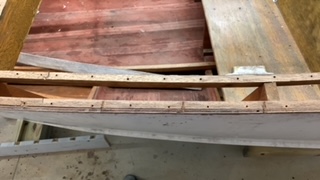
14’ 1956 Chris Craft, side rail how should it be attached?
Apr 12, 24 03:38 AM
 Removing the old side rail most of the screws went between the top deck/skin 1/4” plywood and the side of the hull. See photo, is this correct? I would
 -
How to laminate plywood on the hull
Apr 10, 24 03:46 AM
I'm working on replacing the bottom of 18' 1969 runabout that has a deep-V plywood hull. It had a 1/2 mahogany plywood bottom that they somehow got to



This work is licensed under a Creative Commons Attribution-ShareAlike 2.0 UK: England & Wales License.
I am perfectly aware that the majority of Wooden Boat aficionados are sensible folk.
However, I need to point out that I am an amateur wooden boat enthusiast simply writing in order to try to help other amateur wooden boat enthusiasts.
And while I take every care to ensure that the information in DIY Wood Boat.com is correct, anyone acting on the information on this website does so at their own risk.