Clamps / Cramps
Accumulate
as many
Clamps or Cramps as you can before
starting work on your wooden boat,
It is perfectly true that you can never have too many and preferably of all sizes and types when boat building.
For all those major
boat building jobs its best to have good quality tools as
poor cramps can cause a lot of frustration.
However, there is also a place for even those cheap plastic spring variety.
The more woodworking and boat building you do the more uses you will find for these versatile tools.
- As an extra hand for anyone working alone.
- To hold a straight-edge while marking or sawing.
- To hold pieces for accurate boring.
- To hold braces as you square up.
- To secure work while you plane or chisel.
- And of course for holding while gluing.
- And don't forget about the 'Spanish windlass' or the Wire Twister Tool.
'G' Cramps.
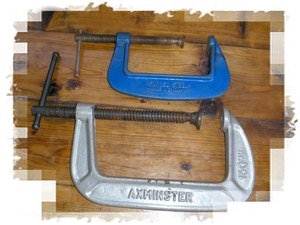 G Clamps
The iron 'G' cramps are the maids of all work, they are robust, available in a range of sizes, easy to use, cheap and almost indestructible.
A useful variation is the 'Edge cramp' which has an extra screw in the centre of the 'G', these are useful holding lips and curved surfaces.
The standard throat clearance is sufficient for most edge clamping.
However, deep throat or long reach versions are available.
Sizes usually refer to the maximum size of piece which can be held between pads.
These are meant to be tightened by hand using the tommy bar, using any greater leverage may damage the cramp and the work piece.
They do have a tendency to
lose their buttons, these can
be pressed back on and secured using a punch.
Always use wooden pads to protect your work.
The pads can be stuck
temporarily to the cup with a bit
of Blu-Tack while positioning.
Bar/sash Cramps.
For edge gluing panels, for bulkheads, transoms and the like there is little to beat the reach and grip provided by a sash cramp.
These are available in a range of sizes with the sliding jaw providing rapid adjustment from the maximum length right down to zero.
The screw adjusted jaw is fixed to one end of steel bar while the sliding jaw can be positioned to suit.
There are various ways in which the sliding jaw is held.
From the traditional simple through pin, to a variety of Fast action, and cam cramps.
Some have 'T' section bars for
extra
rigidity.
They have the advantage that they can be placed close together as there is no need to allow room to turn the tommy-bar.
Also available are the fast
action type where both jaws
are movable, by tightening the screw both jaws lock and jam on the
bar.
Cramp heads are also available which can be fitted on to a wooden baton.
affiliate linksPipe Cramps.
These are similar to the bar cramps in principal, but using steel piping in place of the flat bar.
One end of pipe is threaded to take the adjustable jaw, while the movable jaw can be fixed anywhere along the pipe with either a cam action leaver or with a clutch which tightens as load is applied.
Rugged hard working they normally have shallow throats, however deeper jaws can now be bought.
For some of those unusual boat building applications the pipe can be bent to fit.
Where that extra bit of pressure is required when edge setting planks, the pipe can be bent to fit the curve of the hull.
affiliate linksSpring Cramps.
Don't disregard
the cheap and cheerful spring loaded cramps, the ones that look like
big
clothes pegs.
They
are immensely useful when you want an extra hand just to hold something
in
place while figure out what to do next.
The plastic variety with their
contoured jaws, to avoid
marking your work piece, have a surprising amount of clamping power and
are so
easy and quick to position.
Use one of these when you are sawing a plywood panel to clip the end of the cut together, it will stop the ends flapping.
affiliate linksMitre Cramp.
These are specially designed to hold mitered joints together at right angles.
affiliate linksVice Grip.
These are basically the vice
grip/mole grip tool that is in every tool box.
However there are deep throat varieties which can be used by the wood boat builder.
They can be useful when lapstrake planking.
However you need to be careful of their immense clamping pressures when working with wood.
affiliate linksLapstrake Clamps.
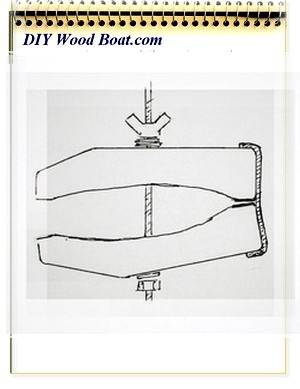
When building a lapstrake construction, tight clamping of the lap joints is essential.
Traditional style lapstrake cramps can be bought from specialist tool suppliers.
However, they are simple to make.
By making you own to order you can make them in whatever size you need.
All you need are some hardwood off cuts, some threaded studding, nuts, wing nuts and washers.
And a scrap of leather or webbing for the hinge.
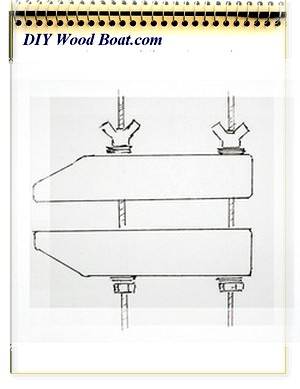
Or instead of the 'hinge' use a second length of studding.
These are handy as the jaws can be closed in a variety of angles.
The hand screw types are similar and just as easy to make.
See also John Sheen's DIY Lapstrake Cramps
affiliate linksNATIVE ASYNC


Recent Articles


-
Wooden Boat Events 2024
Apr 14, 24 05:15 AM
Wooden Boat Events 2024 calendar, traditional and classic boat festivals and regattas from around the world
You might like these
Boatbuilding Tools for the Wooden Boat Builder.
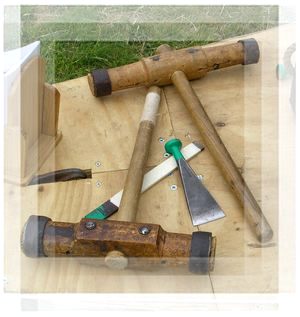
The Boatbuilding Tools needed for building renovating or repairing wooden boats and how to sharpen and care for them.
Wire Twister Tool
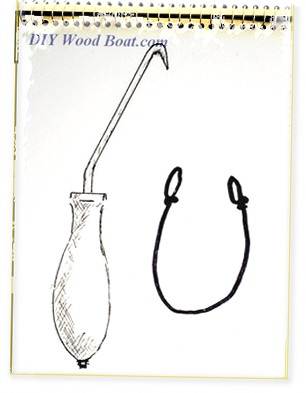
Tightening the stitches on a stitch and glue construction will be easier with a Wire Twister Tool, a cheap and simple gadget
Using a Hand Saw
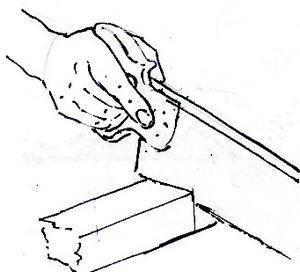
Using a hand saw, how to cut straight and square by hand with a wood saw.
Tool Care
Tool care, how to keep your boat tools rust free, shiny and sharp, especially those you keep onboard.
Sharpening and Honing
A guide to Sharpening and Honing woodworking tools, sharpening stones and strops for a keen edge.
Screwdrivers for DIY.
A bit about Screwdrivers and their use on wooden boat building projects.
Drilling Bits and Drills for Wooden Boat Building.
Drilling Bits, what you need to know about twist bits, augers, hole cutters, countersinks when building a wooden boat.
Spiling
Spiling the lining off or copying a curved shape, such as a plank using an intermediate object such as a straight line, a moulds edge, rule staff or a partial template.
Caulking Irons.
A description of the tools needed if you are caulking a carvel boat. Including some you can make for yourself.
Bench Planes, DIY tools guide.
Bench Planes for the wooden boat builder, the ones you are likely to need, a brief description of the various types.

Recent Articles
-
Wooden Boat Events 2024
Apr 14, 24 05:15 AM
Wooden Boat Events 2024 calendar, traditional and classic boat festivals and regattas from around the world -
14’ 1956 Chris Craft, side rail how should it be attached?
Apr 12, 24 03:38 AM
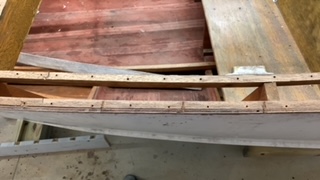
 Removing the old side rail most of the screws went between the top deck/skin 1/4” plywood and the side of the hull. See photo, is this correct? I would
 -
How to laminate plywood on the hull
Apr 10, 24 03:46 AM
I'm working on replacing the bottom of 18' 1969 runabout that has a deep-V plywood hull. It had a 1/2 mahogany plywood bottom that they somehow got to
You might like these
Plywood and Veneer Guide for Marine use.
A guide to plywood for boat building and why you should use the best marine grade you can afford.
DIY Woodboat Building Questions
Woodboat building questions a Forum for wooden boat building, plans, lumber, caulking compounds and other boat building problems.
Boat Books for Wooden Boat Builders
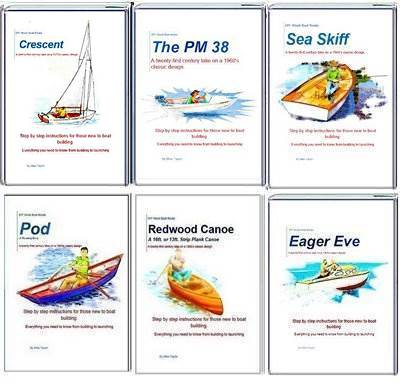
Boat Books a series of boat books based on some of the 1960's, classic, Free Boat Plans that were published in magazines such as "Popular Mechanics", "Popular Science" and the "Boat Builder Handbook".
Build a Boat, tips for the DIY Wooden Boat Builder.
How to Build a Boat, Wooden Boat Building methods for the DIY, backyard, self-builders explained, carvel, lapstrake and plywood
Clench Nails, Fastening for Small Wooden Boats.
How to use Clench Nails, these provide a fast reliable method for fastening small wooden boats.
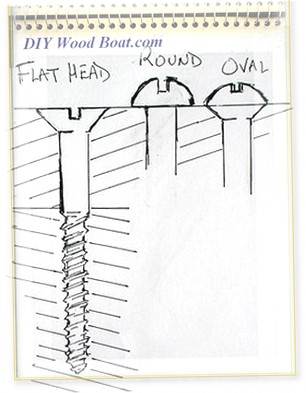
Wood Screws for Boat Building and Repair.
Wood Screws are the most widely used and versatile fasteners used on wooden boats. Which type to use and how to use them
Timber, Lumber for Boat Building.
A brief description of the most common Timber used for building Wooden Boats how to choose wood for your project boat



This work is licensed under a Creative Commons Attribution-ShareAlike 2.0 UK: England & Wales License.
I am perfectly aware that the majority of Wooden Boat aficionados are sensible folk.
However, I need to point out that I am an amateur wooden boat enthusiast simply writing in order to try to help other amateur wooden boat enthusiasts.
And while I take every care to ensure that the information in DIY Wood Boat.com is correct, anyone acting on the information on this website does so at their own risk.